Five quantity-distance and risk modes, all drawn to scale on real satellite imagery of the actual
site instead of an abstract CAD drawing — a deterministic k-factor envelope for a fast first
pass, the full IATG 02.20 PES×ES matrix, non-standard buildings with their own per-wall template,
and a probabilistic DDESB TP-14 QRA with a separate burning-case thermal model alongside it.
Every result is exportable as a branded, citable PDF report.
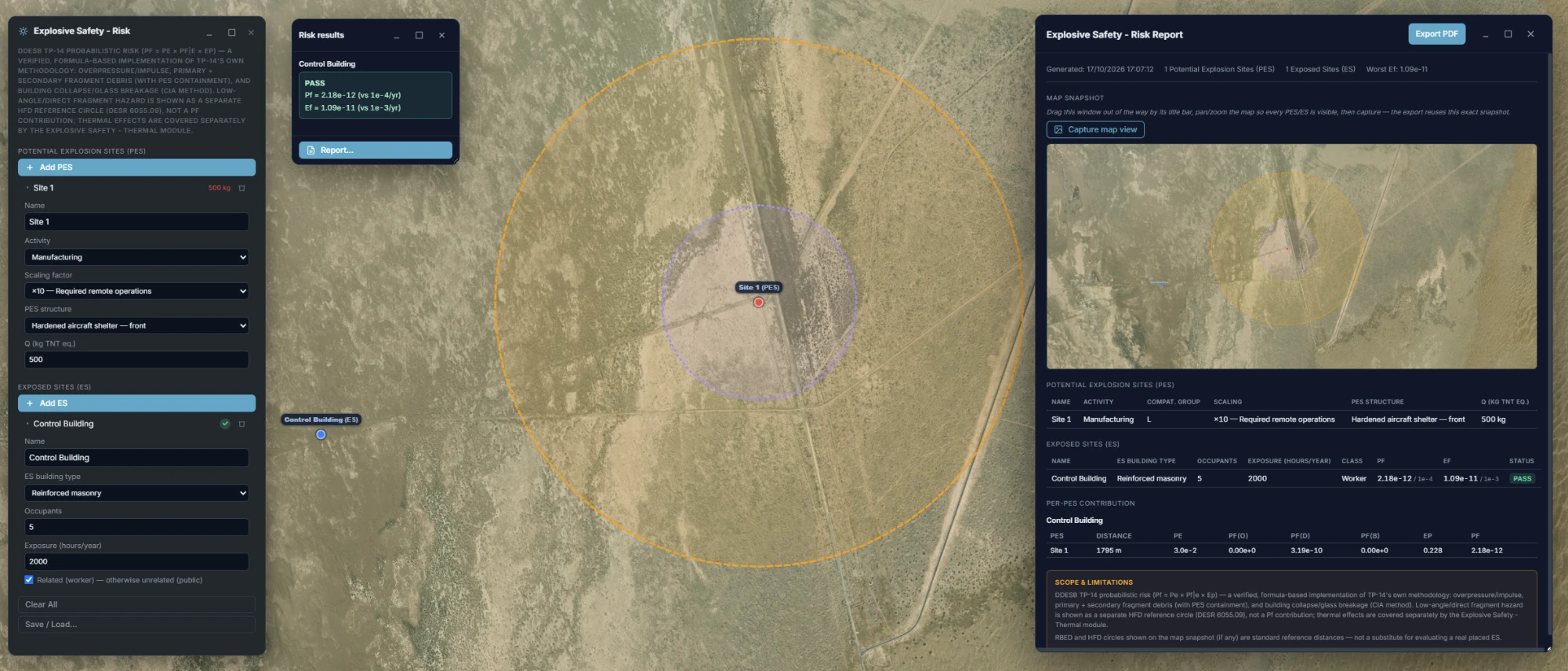
Probabilistic QRA
Risk — DDESB TP-14, worked as a real probability
Pf = Pe × Pf|e × Ep, DDESB Technical Paper 14's own methodology, not a simplified stand-in for
it: the real Figure 3 event-probability matrix, overpressure/impulse, primary and secondary
fragment debris with PES containment reduction, and building collapse/glass breakage through
the public CIA method — the same substitute DNV's own Phast/Safeti software documents for
TP-14's unpublished proprietary model.
Two reference circles, not one
RBED — the distance at which a person in the open, exposed continuously, reaches the public
risk criterion (1E-6/yr) — alongside a second, genuinely different DoD criterion: DESR
6055.09's Hazardous Fragment Distance (HFD), for the low-angle, flat-trajectory cased-munition
fragments that TP-14's own direction-independent debris model does not cover. Both drawn per
PES, both deterministic reference distances, never folded into the Pf a placed Exposed Site
actually gets.
A result per Exposed Site, not a zone
Unlike every other mode here, the real answer depends on what is actually at that specific
site — occupancy, exposure hours, worker vs. public classification — so Risk reports a
PASS/FAIL per Exposed Site against the DDESB criterion that applies to it, with the full
Pe/Pf(o)/Pf(d)/Pf(b)/Ep breakdown for every contributing PES.
What this is, and what it is not. This is a verified, formula-based
implementation of three of TP-14's own mechanisms — not a complete TP-14/IMESAFR-equivalent QRA.
Secondary fragments are not yet modeled for pre-engineered metal buildings (Table 8 has no
throw-distance data for that type at all); thermal effects are a deliberately separate scenario
(see below), never mixed into this Pf.
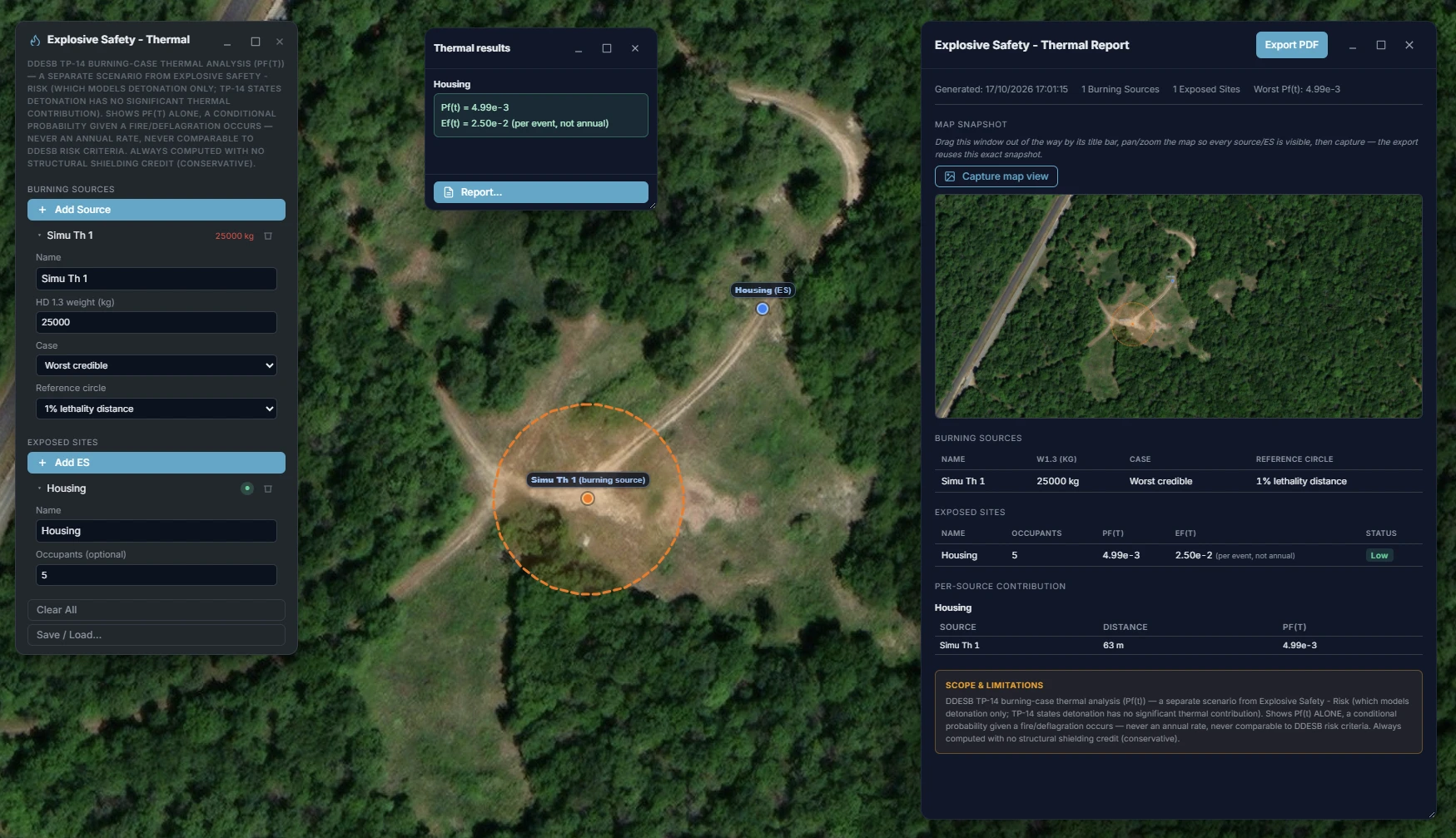
Thermal — a separate scenario, not a missing branch of Risk
TP-14 states it directly: a detonation-case event has no significant thermal contribution, and
a burning-case event uses an entirely different equivalent NEW. Thermal is its own mode for
exactly that reason — fireball radius and duration from TP-14's own equations, radiative
temperature at the Exposed Site, and a fatality probability read off TP-14's own digitized
threshold curves.
Three credible cases, your choice
TP-14's own Table 3 best/average/worst-case yield for the HD 1.3 material actually present —
"best" is zero yield by the table's own definition, not a computation gap. A conservative
reference circle marks the distance at which Pf(t) crosses the 1%, 50% or 100% threshold
curve, selectable per source.
Per event, never an annual rate
Pf(t) is a conditional probability — given that a fire or deflagration actually occurs — and
is never compared against the DDESB annual risk criteria Risk itself uses. Every figure in
the results window and the PDF report says so explicitly, so it is never mistaken for an
annualized number.
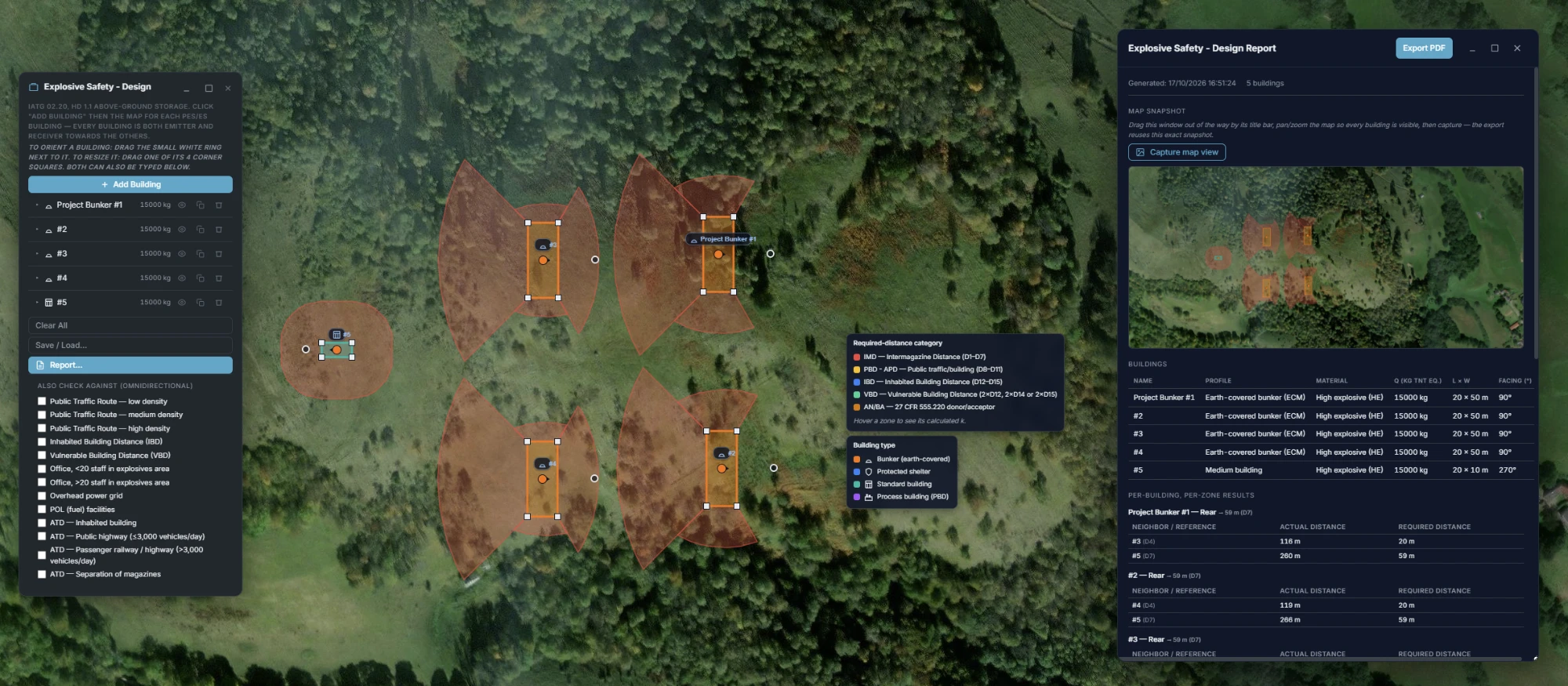
Design — every building, emitter and receiver at once
The full IATG 02.20 Hazard Division 1.1 above-ground storage matrix: every placed building is
simultaneously a Potential Explosion Site toward every other and an Exposed Site receiving from
them, resolved through the real UN SaferGuard PES×ES quantity-distance table — not a flat
generic k-factor.
Oriented, to-scale footprints
Drawn at the real building's length and width, turned with a rotate-dial handle and resized
by dragging a corner, so the model lines up with what is actually on the ground — earth-covered
bunkers get distinct front, side and rear hazard cones, colour-coded by severity and
recomputed live as buildings move or turn.
AN/BA and ATD, not just IATG
Ammonium-nitrate/blasting-agent pairs route through 27 CFR 555.220's own donor/acceptor
distances instead of the IATG HE matrix the moment either building's material isn't plain
high explosive, and 27 CFR 555.218's reference types — inhabited buildings, public highways,
passenger railways, magazine separation — are checked against every site, barricaded status
read straight from the emitting building's own construction.
Every neighbor, not just the worst case
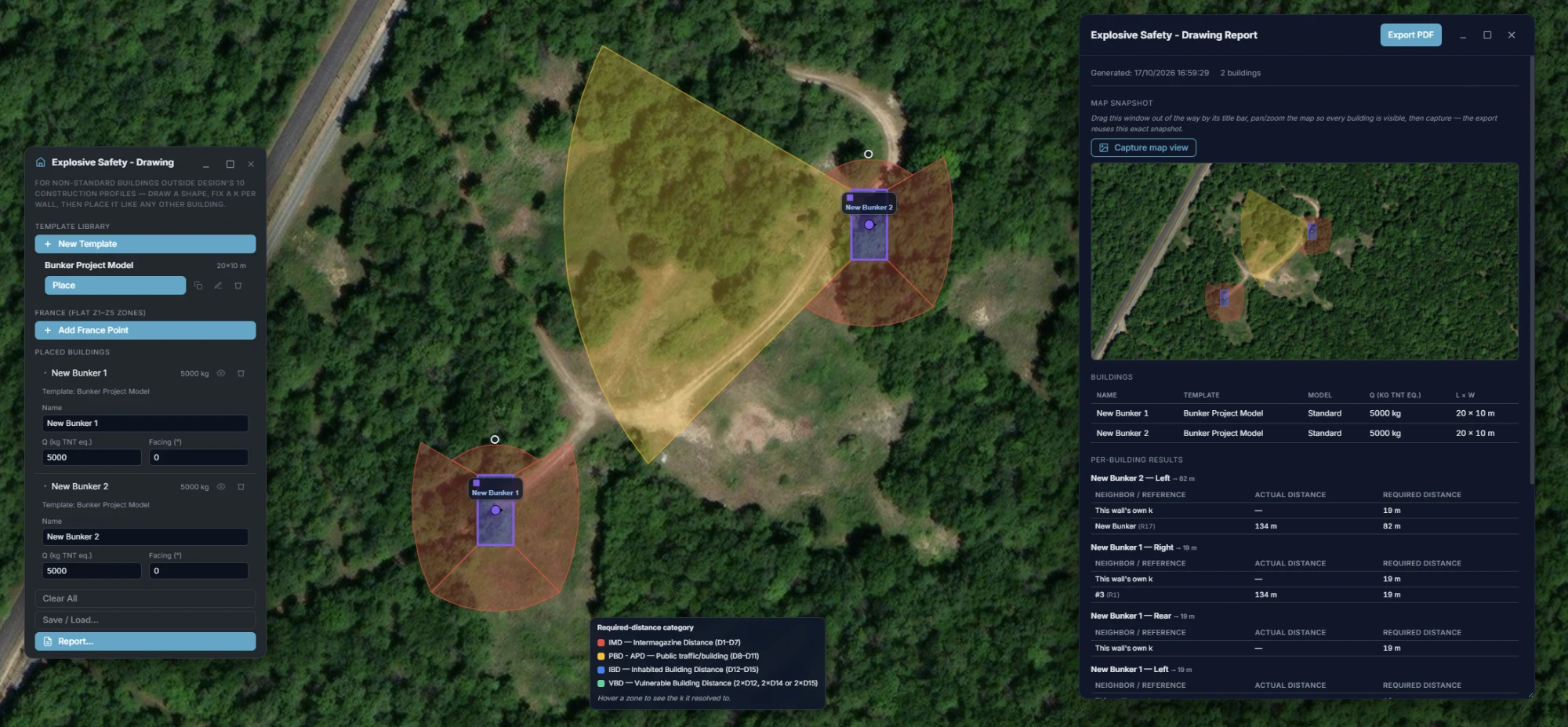
The distance a zone is drawn to is always the worst case among every applicable neighbor — the
PDF report lists each one individually, actual distance against required distance, so the
number behind the drawn zone is never a black box.
Explosive Safety - Design · full IATG 02.20 PES×ES matrix, directional hazard zones
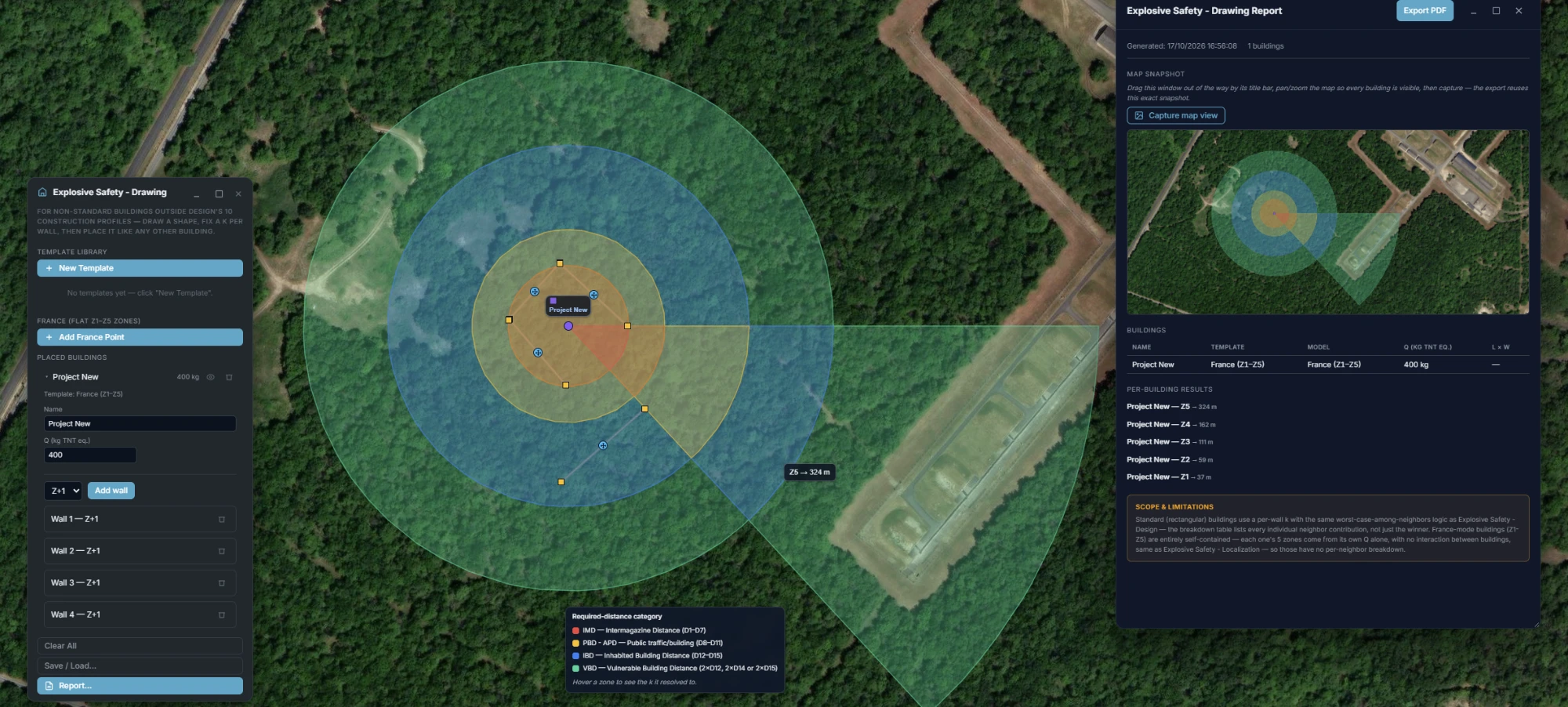
Non-standard buildings
Drawing — outside Design's 10 construction profiles
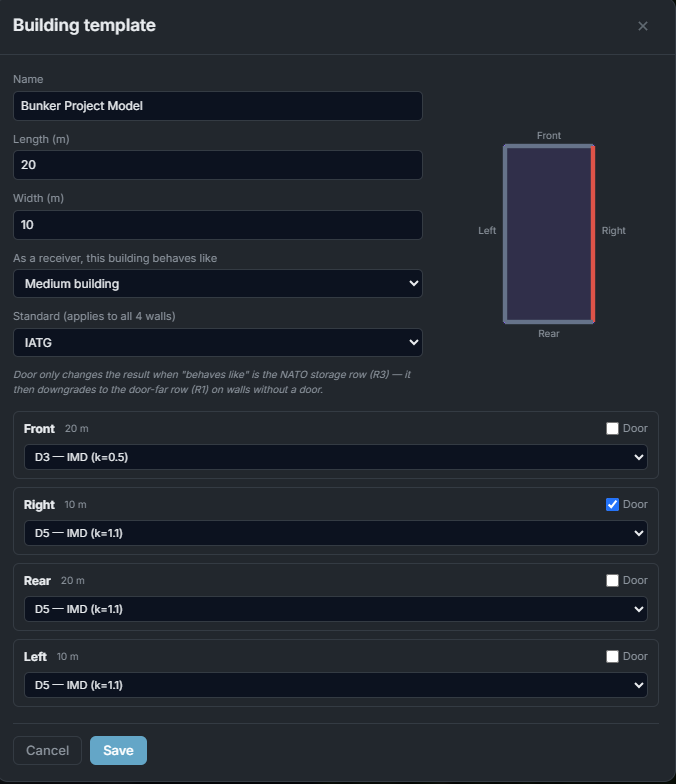
For the building that doesn't fit any of Design's standard profiles: draw a custom footprint,
fix a k-factor per wall from a saved template, and place it like any other building — plus a
second, entirely self-contained model built around how France's own regulation actually works.
A real per-wall template editor
Length, width, how the building behaves as a receiver, and an IATG D-code picked per wall —
front, right, rear, left — each with its own door checkbox (a NATO R3 storage row downgrades
to the door-far R1 row on a wall with no door). Save it once, place it as many times as
needed, edit every placed instance independently afterward.
The French Z1-Z5 model, properly separate
France's own regulation doesn't direct a k-factor per wall at all — five concentric
omnidirectional zones (Z1-Z5) from the building's centre, with a protection wall able to
re-label the zones behind it by one or two tiers without ever moving the physical radii
themselves. A fundamentally different shape from IATG, so it gets its own point type rather
than being forced into the wall-based model.
Explosive Safety - Drawing · French Z1-Z5 flat-zone model alongside a standard IATG building
Explosive Safety - Drawing · two custom buildings from one saved template, per-neighbor breakdown
Fast first pass
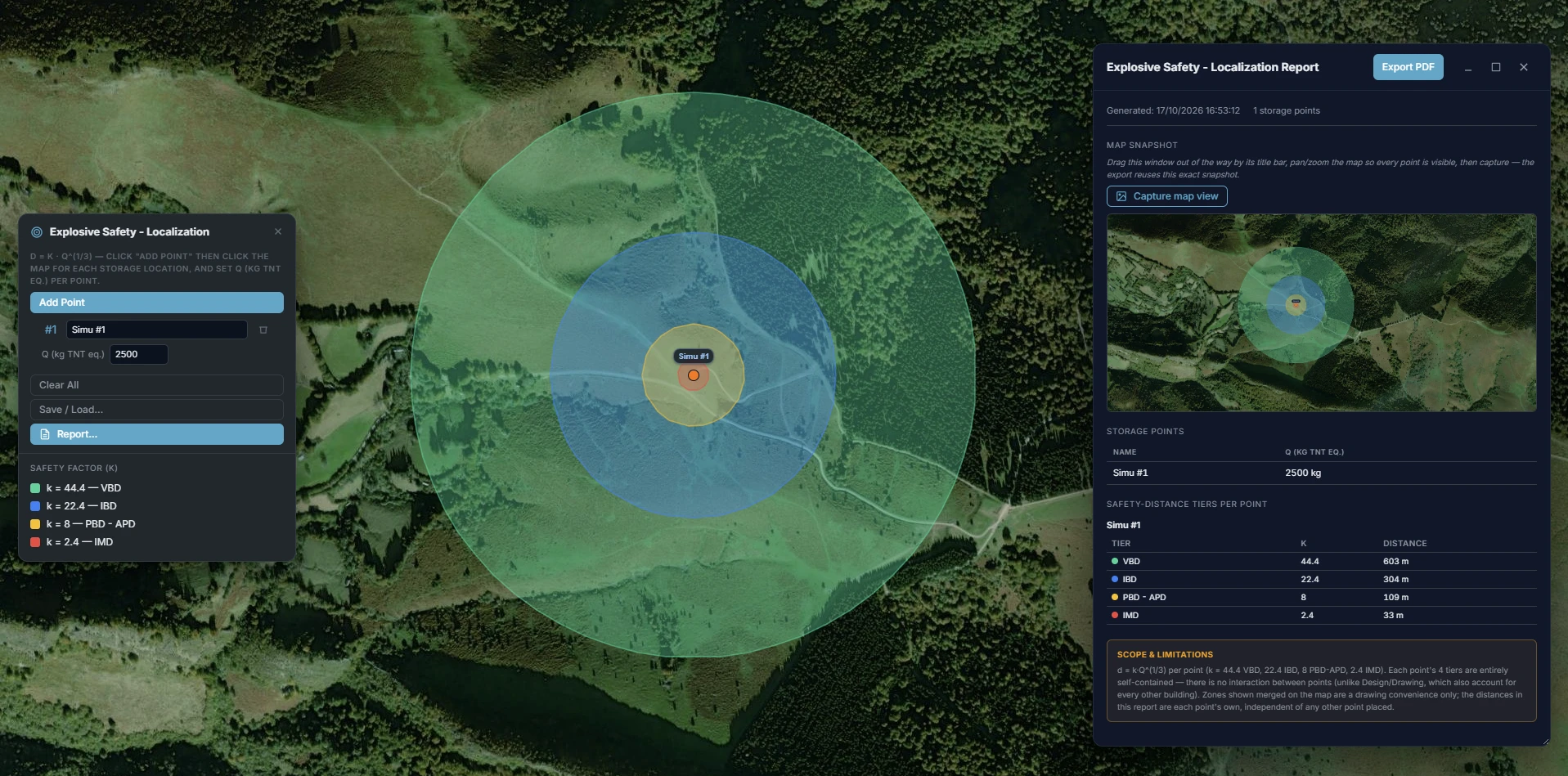
Localization — a four-tier envelope in one click
d = k·Q^(1/3) at four fixed safety factors — VBD, IBD, PBD-APD, IMD — around every storage
point, entirely self-contained: no interaction between points, no building profile to pick,
just a quantity and a map click. The quick-sketch mode alongside the full matrix tools, for
when a fast envelope is what the moment actually calls for.
Explosive Safety - Localization · four-tier k-factor envelope for a fast first pass
Every result, a report someone else can read
All five modes share the same branded PDF export — a map snapshot, the full input and result
tables, and the scope & limitations of exactly what was computed, never left implicit.